
If you’ve spent any time around sprint coaching in the last decade, you’ve heard the phrase “frontside mechanics.” It’s become gospel. Get the knees up. Minimize backside. Keep everything in front of the body. Coaches repeat it like scripture, and the athletes nod along and exaggerate their knee drive until they look like they’re marching in a parade instead of sprinting.
Here’s the problem: the research doesn’t say what most coaches think it says.
What the Research Actually Found
The landmark study here is Haugen and colleagues, published in 2018 in the International Journal of Sports Physiology and Performance. Twenty-four competitive sprinters, 3D motion capture with 21 cameras at 250 Hz, analyzing both acceleration and max velocity phases. This isn’t a small convenience sample filmed on an iPhone. It’s rigorous.
The findings surprised a lot of people. Several frontside and backside variables — thigh angle at lift-off, knee angle at lift-off, maximal thigh extension — did correlate with acceleration performance. Correlations ranged from r = .51 to r = .66. That part lines up with conventional coaching wisdom.
But here’s where it gets interesting. During max velocity sprinting, NONE of the frontside or backside variables were significantly associated with performance. Zero. The variables that actually predicted max velocity were horizontal ankle velocity, contact time, and step rate.
In other words, among trained sprinters running at top speed, the thing that separated fast from faster had almost nothing to do with knee drive or thigh angle. It had to do with how quickly and forcefully they hit the ground and how fast they got off it.
The study’s conclusion: “the present findings did not support that front-side mechanics were crucial for sprint performance among the investigated sprinters.”
That should have been a cold shower for the coaching community. For many, it wasn’t.
Why Coaches Got It Backwards
What happened is a classic case of confusing what fast looks like with what makes someone fast.
When you watch elite sprinters in slow motion, their frontside mechanics look incredible. High knee recovery, tight heel tuck, aggressive thigh drive. It’s beautiful. So, many high school coaches reasonably assumed those positions were causing the speed. They started drilling knee drive, cueing “frontside,” and building entire sprint programs around achieving those positions.
The problem is that those positions are largely a CONSEQUENCE of applying massive force into the ground in very short contact times. They’re not the cause. When an elite sprinter applies 4-5 times their bodyweight into the ground in under 100 milliseconds, the reactive forces whip the limbs through recovery with enormous angular velocity. The “frontside” positions you see on film are the result of what happened during ground contact, not what the athlete was thinking about during swing phase.
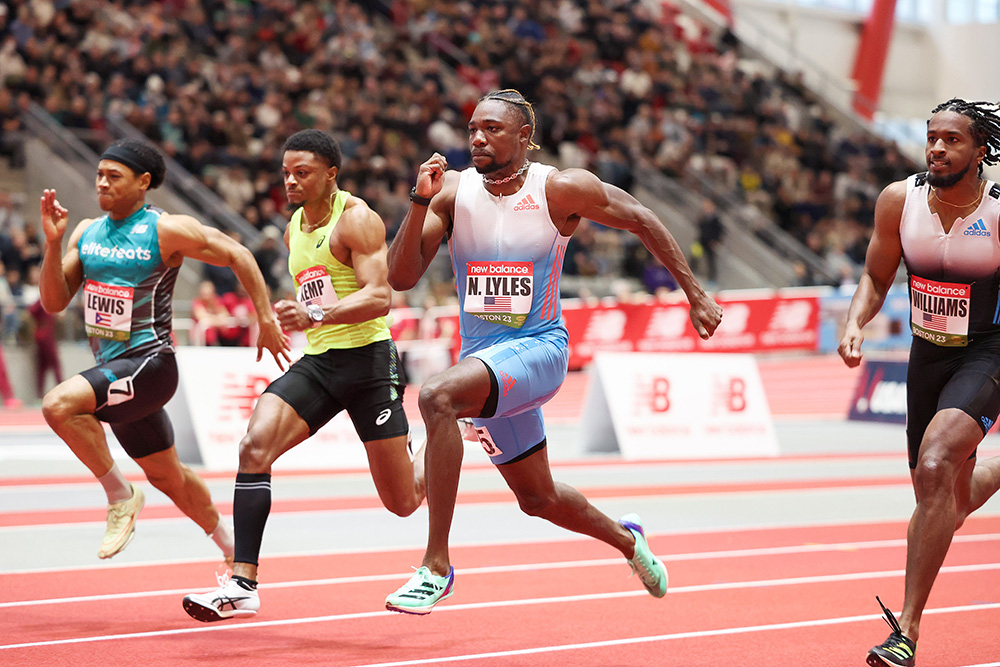
Clark and colleagues confirmed this in 2020 with their “Whip from the Hip” research. Faster sprinters had greater thigh range of motion, and that ROM was distributed more to the frontside. But the mechanism was ground contact mechanics driving thigh angular velocity, not conscious knee drive.
What This Means For Your Athletes
Does this mean frontside mechanics don’t matter at all? No! It means the coaching emphasis is misplaced.
Cueing an athlete to drive their knees higher doesn’t make them faster. It makes them think about their knees instead of attacking the ground. I’ve watched athletes slow down from excessive knee drive cues because they started reaching for positions instead of sprinting. They look more “technical” and run worse times. Any track coach worth their whistle has seen this happen.
What actually matters for developing faster sprinters is force application. How hard can they hit the ground, how quickly can they do it, and can their foot and ankle handle the strain? That’s a strength and power question, not a drill question. Heavy posterior chain work, plyometrics, and actual sprinting at max effort develop the qualities that produce fast ground contacts.
Technique is essential to speed, but it’s not enough by itself. Drills can and should reinforce mechanics, but they can’t replace the ability to produce force.
The exception is an athlete whose hip flexors are too weak to handle the extreme demands of high-speed recovery, or whose anterior core can’t support proper hip stacking under fatigue. For these athletes, targeted technical and strengthening work addresses a structural limitation that force production alone won’t fix.
However, for acceleration, there’s stronger evidence that frontside variables play a role. The Haugen data showed meaningful correlations during the acceleration phase, and a 2021 study of world-class sprinters at the World Indoor Championships found that trunk angle and thigh separation at takeoff explained nearly 90% of performance variance in the first ground contact. So coaching frontside positions during the drive phase of acceleration has more support than coaching it at top speed.
Acceleration coaching can reasonably emphasize limb positions and angles. Top speed coaching should emphasize ground contact quality and let the recovery mechanics follow from the forces produced.
Stop Coaching the Symptom
The research on sprint mechanics is still developing, and there’s genuine complexity here. Individual limb lengths, step frequency strategies, and strength profiles all influence what “optimal” looks like for a given athlete. But the broad trend in the literature is clear: force production and ground contact characteristics drive sprint performance more than the limb positions coaches have been obsessing over.
If your sprint program is built around knee drive drills and frontside cueing at top speed, you’re coaching the symptom. Coach the cause. Get your athletes stronger, more explosive, and let them actually sprint. The mechanics will follow the physics.
References
Haugen T, Danielsen J, Alnes LO, McGhie D, Sandbakk Ø, Ettema G. On the Importance of “Front-Side Mechanics” in Athletics Sprinting. Int J Sports Physiol Perform. 2018;13(4):420-427.
Clark KP, Meng CR, Stearne DJ. “Whip from the Hip”: Thigh Angular Motion, Ground Contact Mechanics, and Running Speed. Biol Open. 2020;9(10):bio053546.
Bezodis IN, Nagahara R, et al. Kinematic Factors Associated with Start Performance in World-Class Male Sprinters. J Biomech. 2021;125:110571.