
In most high school soccer programs, sprint training focuses on top-end speed and first-step acceleration. One crucial piece is missing from the vast majority of programs: reactive strength. This is the skill that lets athletes absorb force rapidly and reapply it with minimal ground contact time: essentially, it’s the ability to bounce.
That “bounce” is especially critical in transitions and quick changes of direction. Without it, all athletes – even strong ones – appear slow or “heavy” in games. Unfortunately, that slow appearance usually leads to more conditioning focus, which fails to fix the problem and can actually worsen it.
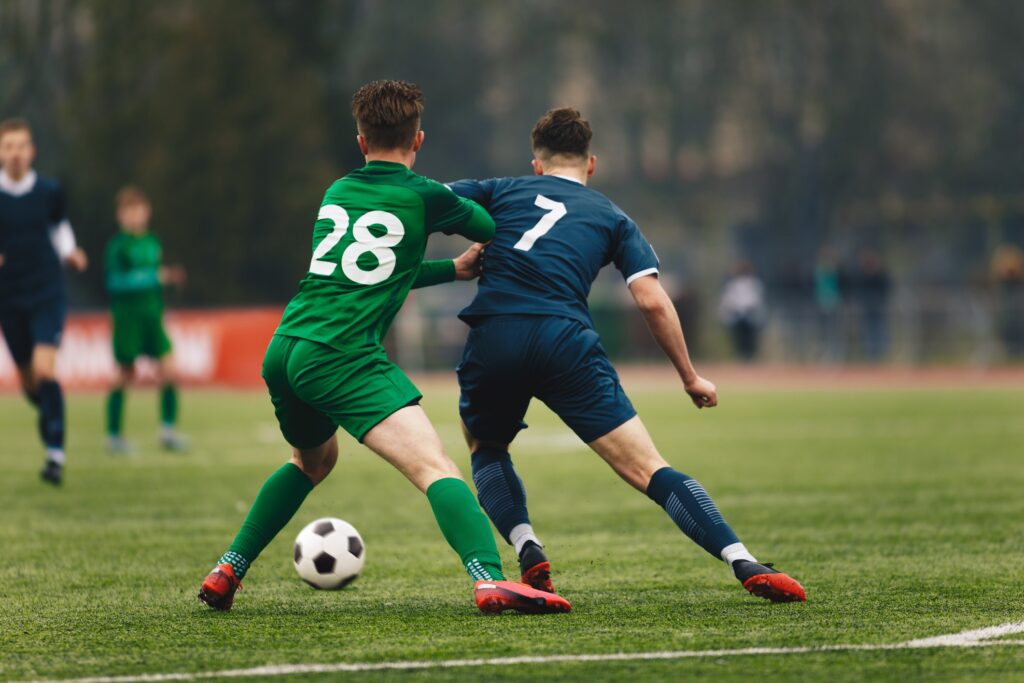
Reactive strength is very specific, and often mis-trained. It’s about how quickly the stretch-shortening cycle (SSC) activates and recycles energy, not about the size or maximum strength of the muscles. This often means that it is undertrained (or completely ignored) at the high school level.
Being highly reactive requires strength, but it’s not the same as strength. Training the SSC requires very short ground contact times, which cannot be replicated with conditioning or endurance training. That’s why more time conditioning can actually make the problem worse.
The Benefits of Bounce
Athletes with poor SSC efficiency exhibit longer ground contact times, inefficient force transfer, and are more likely to over-rely on passive structures like ligaments. This directly increases their risk for Achilles and patellar tendinopathy, even ACL injury, particularly when decelerating from high-speed sprints into a lateral change of direction or sudden stop.
Beyond elevating injury risk, a lack of reactive strength also empties an athlete’s endurance “tank” more quickly than it does in teammates who possess good bounce.
That’s because each step they take uses more raw energy and effort than a stride that recycles elastic energy efficiently. Becoming more mechanically efficient can improve endurance by 20% in soccer players without spending more time doing endurance work.
If the notion that short duration work of a few seconds can enhance endurance feels counter-intuitive, you’re not alone. I unpack the mechanisms of how strength improves endurance in detail here. Sprinting’s effects on endurance are similar. But while true sprint sessions build reactive strength far better than any conditioning training, most players still need specific reactive plyometric work. It fills the gaps that remain.
Focus the Training
The good news is that the capacity for an athlete to “bounce” is trainable. Force plate data and contact timing studies consistently show that even submaximal drop jumps from 7 – 12 inch boxes, with instructions to “get off the ground as fast as possible”, are effective for well prepared athletes.
Likewise, sprint-float-sprint drills or band-resisted “snap-down” landings can reinforce the fast eccentric-to-concentric transitions needed in play. Keep the box height low so ground contact times stay extremely brief.
However, drills done without maximal intent lose much of their effectiveness. Athletes need to attack with focus.
Cueing them to minimize time on the ground, rather than maximize height, helps focus on the short contact times needed for reactive improvement. Cueing height or distance is great for overall power development, so it shouldn’t be ignored either. Have a specific focus for both exercises and verbal cues, ensuring each aligns precisely with the skill you are targeting.
Enhancing an athlete’s bounce improves cutting speed, reduces fatigue-related mechanical breakdowns, and makes players more resistant to late-game injury. It’s the difference between looking quick and being quick, and the missing link in most soccer speed programs. Coaches who consistently layer reactive work into training build both faster athletes and more durable ones, who can finish strong in the chaos of the game.